
Search
26 April 2024
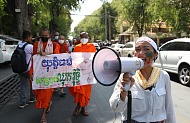
Youths from the Mother Nature Movement and other activists today led a commemorative walk in honour of murdered environmental activist Chut Wutty. Wutty was shot dead on 26 April 2012 whilst patrolling a protected forest area with two journalists in Koh Kong province. A military police officer, In Rattana, was also fatally shot on the same day and blamed for Wutty’s killing following a flawed investigation.
Around 20 youth activists from Mother Nature and six monks gathered in front of Phnom Penh’s Night Market this morning to begin the march. Participants painted messages on their faces and wore white headbands, conducted chants, held a short performance, and carried banners calling for justice for the murder. The march concluded at Hotel Cambodiana, where participants submitted a petition calling for an independent investigation into the killing to authorities from the Ministry of Justice.
8 April 2024
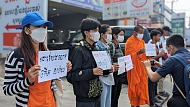
We, the youth, local communities, unions, associations, and local civil society organisations mentioned below are deeply disappointed by the arrest of Mr. Koet Saray, the President of the Khmer Student Intelligence League Association (KSILA).
Note that Mr. Koet Saray was arrested by plainclothes police officers in Phnom Penh and sent to the Phnom Penh Capital Court at 3:45pm on April 5, 2024, while he was working at the office. Mr. Koet Saray, the President of the Khmer Student Intelligence League Association (KSILA), was arrested and sent to Phnom Penh Capital Court without clarification of the exact charge or notice to his family. The arrest was made on the order of Mr. Seang Heang, Deputy Prosecutor of the Phnom Penh Capital Court, on April 5, 2024 under the charge of incitement to commit a felony or to disturb social security. According to a press release issued by the Phnom Penh Capital Court Prosecutor's Office, he faces an additional charge of committing a misdemeanor after sentencing for a misdemeanor, and was sent to pre-trial detention at Prey Sar Prison during the afternoon of April 7, 2024.
7 April 2024
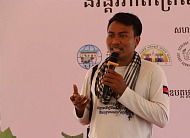
Koet Saray, President of the Khmer Student Intelligent League Association (KSILA), was today sent to pre-trial detention at Correctional Centre 1 prison by an investigating judge at the at Phnom Penh Capital Court following charges of “committing a misdemeanour after sentencing for a misdemeanour” and “incitement to commit a felony” under Articles 88, 494, and 495 of the Criminal Code. The charges relate to ongoing land conflicts in Preah Vihear province.
On 6 April at around 3:30pm, police officers confirmed that Saray had been transported to the Phnom Penh Capital Court from the Phnom Penh Police Commissariat, where he had been held overnight following his arrest on 5 April at around 4:00pm by approximately 10 mixed uniformed and plainclothes police officers outside of KSILA’s office in Phnom Penh. Saray’s arrest followed an order issued by the Office of the Prosecutor at Phnom Penh Capital Court on 5 April to bring Saray to Phnom Penh Capital Police for questioning on “incitement to cause serious chaos to social security”.
One monk and around a dozen individuals from various youth groups and civil society organisations had been present at the Phnom Penh Police Commissariat on 6 April to monitor the situation. A few plainclothes police officers had also been deployed nearby, where they took photographs and videos and prevented human rights defenders from bringing food to Saray.

19 March 2024
On 13-15 March 2024, representatives of social impact investor Oikocredit, Ecumenical Development Cooperative Society U.A. and of three human rights NGOs, Cambodian League for the Promotion and Defense of Human Rights (LICADHO), Equitable Cambodia and FIAN Germany, came together for a dialogue. This was part of the process related to the submission made by the three NGOs to the Dutch OECD National Contact Point for Responsible Business Conduct concerning the alleged negative impacts of some microfinance loans on Cambodian borrowers.
During the dialogue, there was strong common ground between the parties in their commitment to improve the livelihoods of Cambodian borrowers. There was also a joint recognition of the urgent issues in the Cambodian microfinance sector and the need to take action to address them. The parties have identified and committed to concrete next steps towards a positive outcome of the dialogue.
The Dutch NCP has commended both parties on their good faith engagement in the ongoing NCP process.
12 March 2024
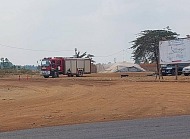
Twenty-nine people were charged by the Preah Vihear Provincial Court on 8 March 2024 with “clearing forestland and enclosing it to claim for ownership” under Article 97(6) of the Law on Forestry. Four of the 29 people charged were released on bail, and the remaining 25 have been sent to pre-trial detention in Preah Vihear provincial prison. They include 13 men and 12 women.
The group was arrested earlier this month after mixed armed forces accompanied by forestry administration officials entered a disputed area with tractors intended to clear the land. Authorities fired live ammunition, used a smoke grenade, and arrested villagers.
The charges are the latest development in a longstanding land dispute involving Seladamex Co., Ltd., which affects families from Mrech, Srayang Tboung, and Kdak villages as well as families who have more recently migrated to the area. Seladamex was granted an Economic Land Concession in 2011 in Srayang and Phnum Tbaeng Pir communes in Kuleaen district.
12 March 2024
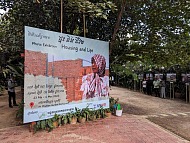
We, the undersigned, are disappointed by the actions of the Sangkat Nirouth Police Station in Khan Chbar Ampov, Phnom Penh, which ordered the owner of Champei Garden Restaurant to stop displaying photographs that were part of an exhibition by Sahmakum Teang Tnaut (STT). The authorities provided no reason or justification for their actions.
The topic of the photo exhibition was Housing and Life , and it had opened on 25 February 2024. It aimed to highlight the ongoing concerns and challenges facing Cambodia’s urban poor communities, with the purpose of finding solutions.
8 March 2024
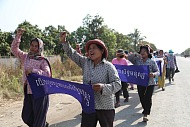
Around 2,000 people gathered across Phnom Penh and multiple provinces including Banteay Meanchey, Battambang, Kampong Chhnang, Kampong Thom, Kampong Speu, Kampot, Koh Kong, Kratie, Preah Vihear, Pursat, Svay Rieng, Stung Treng, and Tbong Khmum to celebrate International Women’s Day 2024. Between 3 March and 8 March, land and Indigenous community members, labour rights activists, youths, children, local authorities, INGOs and local NGOs joined events to give speeches, march together, join discussion forums, sing songs, and share solidarity meals.

7 March 2024
Join us to stop violence, discrimination and harassment against women, human rights defenders, and those who love others of the same gender!
In celebration of International Women's Day 2024, watch this video inspired by the achievements of women across Cambodia in their pursuit of respect for human rights.
6 March 2024
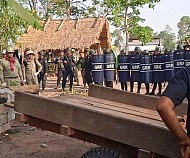
A group of mixed armed forces including gendarmes and police officers accompanied by forestry administration officials mobilised this morning to secure disputed land in Preah Vihear province, resulting in the use of live ammunition and arrests.
A number of villagers have reportedly been arrested and taken to Preah Vihear provincial capital. Their current location is unknown.
Villagers reported that mixed forces armed with automatic rifles had entered the area shortly before dawn, and were accompanied by tractors to clear the disputed land. Fearful of property destruction and forced evictions, villagers gathered to demand the forces leave the area. A confrontation ensued in which a video captured live ammunition being shot repeatedly by authorities as well as the use of a smoke grenade.
27 February 2024
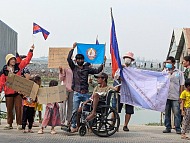
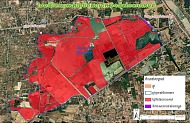
Samrong Tbong Community members this morning reported injuries stemming from an altercation with authorities over the filling-in of the Boeung Tamok lake area in Phnom Penh. The lake has been parcelled off by the state and given away to politically connected institutions and individuals over the past several years.
Members of Samrong Tbong Community gathered at the area yesterday and this morning to protest the state’s excavation of the community’s land. Community members are facing legal complaints in at least four cases that have been opened since 2022 due to their land activism.
27 February 2024
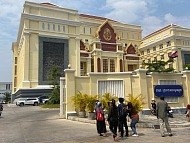
The Phnom Penh Appeal Court this morning upheld a lower court verdict finding Candlelight Vice President Thach Setha guilty of incitement, which imposed the maximum sentence of three years in prison as well as a fine of 4 million riel (about US$1,000). Setha was convicted on the basis of a speech he gave to supporters of the former Cambodia National Rescue Party (CNRP) during a visit to South Korea on 8 January 2023.
Setha was convicted by the Phnom Penh Capital Court on 18 October 2023 of incitement to commit a felony and incitement to discriminate under Articles 494, 495 and 496 of the Criminal Code. This is the second instance in which convictions against Setha were upheld by the Appeal Court in recent months. In January 2024, the Phnom Penh Appeal Court upheld the finding of guilt on a different charge of irregular financial payments, as well as the sentence of 18 months in prison plus fines and compensation. Setha has been in detention for 407 days, since his arrest in January 2023 regarding the charge of irregular financial payments.
26 February 2024
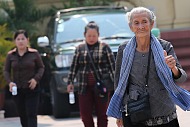
The Supreme Court this morning overturned the convictions of two land activists from the Boeung Kak Lake Community. The activists, 83-year-old Nget Khun (also known as Yeay Mommy) and 58-year-old Cheang Leap, had been convicted by two lower courts of making death threats in March 2012.
Members of Phnom Penh’s Boeung Kak Lake Community faced a prolonged dispute after the government leased the lake to a private company in 2007. Community members were routinely imprisoned and convicted for defending their homes and speaking out against the forced evictions.
The charges related to an incident in which papers printed with death threats against former community member Ly Mom were found scattered outside her home. Ly Mom filed complaints against six Boeung Kak Lake Community members, including Khun and Leap. The six women maintained that they were not responsible for the threats.
22 February 2024
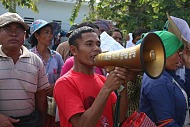
The Phnom Penh Appeal Court this morning upheld the 2021 decision of the Kampong Chhnang Provincial Court convicting three Lor Peang Community members of “obstruction of public official” and “intentionally causing damage” as part of a long-running land conflict. The three community members are Nhem Nhuen (also known as Snguon Nhuen), Reach Seima and Pul Sorn.
Lor Peang Community has resisted community members’ land being encroached by KDC International, a company owned by Chea Kheng, the wife of former Minister of Mines and Energy Suy Sem. The charges stem from an incident in 2013, when KDC International began establishing borders over the disputed land in Kampong Chhnang province. Members of Lor Peang Community arrived at the site to protest, during which a temporary security guard hut was destroyed.
Almost eight years later, the provincial court convicted the three Lor Peang Community members under Articles 503 and 410 of the Criminal Code. All received suspended sentences of 2 years and 6 months and were ordered to pay compensation of 2.8 million riel (approximately US$700), a decision that was today upheld by the Appeal Court.
16 February 2024
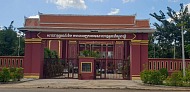
The Tbong Khmum Appeal Court yesterday suspended a two-year prison sentence given to four Srae Prang Community members, who were accused of intentional damage for blocking a private company from clearing their land.
The four community members are part of group of nine defendants who are alleged to have blocked machinery belonging to Harmony Win Investment Co. Ltd. from clearing their land in 2017 and 2020. They were convicted of intentional damage and sentenced to two years in prison in 2021 by a provincial court. The Tbong Khmum Appeal Court upheld the verdict in 2022, but the Supreme Court sent the case back to the appeal court in August 2023.
On Thursday 15 February 2024, the appeal court upheld the sentences of the four community members and suspended their two-year prison sentences. The community members are Chhork Chhey, Khem Sokcheang, Pum Pich and Veun Ver.
.jpg)
15 February 2024
The Battambang Appeal Court today upheld the three-year prison sentence of social activist Kong Saron, who was arrested in July 2023 for political opinions he expressed during a Facebook livestream.
Saron was first taken into custody on 2 July 2023 for comments he published in a video on Facebook during the 2023 National Election campaign period. Saron was released shortly after issuing an apology. However, he was convicted by the Banteay Meanchey Provincial Court on 22 November for incitement to commit a felony, public insult and insulting the king and sentenced to three years. He was arrested on 25 November and imprisoned.
The Battambang Appeal Court upheld Saron’s conviction on Thursday, and he will remain in prison to serve his sentence pending his last appeal.
14 February 2024
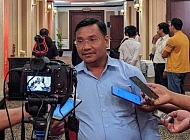
We, the undersigned organisations, associations, unions and communities, are outraged by the threats of legal action against Soeng Senkaruna, a senior staffer at the Cambodian Human Rights and Development Association (ADHOC), over comments attributed to him in a media article. Senkaruna is the Deputy Head of the Human Rights, Land Rights and Natural Resource Section and Spokesperson of ADHOC. He has for years courageously spoken out in defence of human rights and social justice.
The Cambodia Daily Khmer published an article on 2 February paraphrasing Senkaruna as saying that political conflicts should be resolved through dialogue rather than in court. The article also paraphrased Senkaruna as noting that the ruling Cambodian People’s Party (CPP) had regularly used the courts as a barrier to oppress opposition parties.
7 February 2024
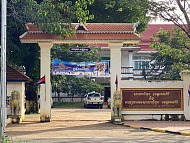
On 7 February 2024, provincial courts convicted two well-known activists in separate cases, continuing the trend of judicial harassment against human rights advocates in Cambodia.
The Ratanakiri Provincial Court earlier today announced its verdict convicting environmental activist Chhorn Phalla of defamation, insult and incitement to commit a felony under Articles 305, 502 and 495 of the Cambodian Criminal Code. The court sentenced Phalla to one year in prison and imposed a 10 million riel (around US$2,500) fine.
Phalla is an outspoken environmental activist who has been repeatedly prosecuted for his advocacy for the protection of natural resources and monitoring of deforestation. Phalla had been imprisoned since September 2021 for criminal charges arising from two other separate cases. Both cases were also based on his activism. Phalla was finally released from prison in October 2023 after his convictions in the other two cases were overturned, only to be again convicted today.
1 February 2024
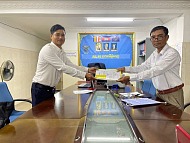
An ongoing crackdown on political opposition members intensified yesterday with two additional arrests of opposition members, as the government continues to jail political opponents ahead of the February Senate Elections.
Ma Chinda, head of the Candlelight Party’s youth movement in Phnom Penh’s Daun Penh district, was arrested on 31 January around the time of a scheduled Candlelight Party meeting in the capital. Hak Kosal, an opposition political activist, was also arrested that day. Kosal had submitted a list of election observers for the Senate Election on behalf of the Khmer Will Party (KWP) to the Phnom Penh Provincial Election Committee (PEC) just a day prior.
30 January 2024
The Phnom Penh Appeal Court this morning held the first trial hearing regarding Kem Sokha’s convictions of treason and conspiracy with a foreign power. Sokha is the former president of the dissolved opposition Cambodia National Rescue Party (CNRP). He was convicted and sentenced to 27 years in prison by the Municipal Court in March 2023, fewer than five months before Cambodia’s July National Election. Sokha was transferred to house arrest pending exhaustion of any appeals.
During the hearing, Sokha’s lawyers requested that the Appeal Court review the restrictive conditions of his bail. However, the judges declined to overturn the conditions of his supervision.
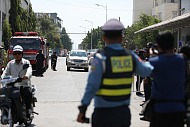
Prior to the hearing, authorities blocked roads surrounding the Appeal Court, preventing members of the public and the media from accessing the front of the court building. The hearing was attended by representatives from NGOs, embassies, and the United Nations. Representatives from a number of news outlets including Radio France Internationale (RFI), CamboJA, and Voice of America (VOA) were not admitted to the courtroom. Around 100 supporters gathered at the blocked road, while journalists and NGO representatives also waited at the barriers. Deployed mixed uniformed and plainclothes police officers and security guards took photographs and videos of individuals in the area.
25 January 2024
We, the NGOs and civil society groups inclusive of the associations and local communities listed below, express our concern about the land security of Samrong Tbong Community in Phnom Penh. Community members may be forcibly evicted as the Royal Government of Cambodia continues to excessively partition and parcel off Boeung Tamok lake. Community representatives continue to face charges and court complaints as a result of their efforts to protect community members’ lands, houses, and housing rights.